
Hope in Every Molecule
Sunil Kumar and his team are developing synthetic protein mimetics that may slow or halt neurodegenerative diseases like Alzheimer’s and Parkinson’s, offering patients and families a glimpse of a brighter future.
By Nika Anschuetz

Associate Professor Sunil Kumar
Associate Professor Sunil Kumar

Ryan Dohoney, a PhD candidate in organic chemistry, is one of the students working in the Kumar Lab.
Ryan Dohoney, a PhD candidate in organic chemistry, is one of the students working in the Kumar Lab.
By 2050, as many as 13 million Americans could be living with Alzheimer’s disease—nearly twice the number who cope with it today. The projection looms over researchers, clinicians, and families as neurodegenerative diseases tighten their grip on society. For many, 2050 feels like a lifetime away, but for Sunil Kumar, associate professor of chemistry and biochemistry in the College of Natural Sciences and Mathematics, it feels much closer—and therefore much more urgent.

In 2019, he launched the Kumar Lab at DU with an ambitious goal: to develop druglike molecules to treat neurodegenerative disorders such as Parkinson’s disease, Alzheimer’s disease, amyotrophic lateral sclerosis (ALS), and Huntington’s disease. Six years later, with funding from the National Institutes of Health, the Department of Defense, the Parkinson’s Foundation, the American Parkinson Disease Association, and others, Kumar and his team are closing in on a potential disease-modifying treatment.
The current treatments
Proteins regulate every function in our body. We rely on protein-protein interactions—proteins binding together to do a job. For people with neurodegenerative diseases such as Alzheimer’s, these interactions go awry. Instead of functioning properly, certain proteins misfold and begin to clump together.
“They function in two toxic ways,” Kumar says. “They build physical barriers between neurons. They can no longer talk to each other. Over time, they start killing neurons.”
As brain cells start to die in large quantities, the brain begins to shrink. Memory loss—the primary symptom of Alzheimer’s disease—occurs because those protein clumps block key pathways.
Currently, there are two types of drugs on the market to treat Alzheimer’s disease, but their effects are limited. They can provide some relief, improving memory and daily function, yet they do not halt or slow the progression of the disease. One type is based on small molecules, and the other uses antibodies.
Developing any drug for the brain is especially challenging because it needs to cross the blood-brain barrier. Small molecules can easily cross that barrier, but they need to be able to target specific proteins. Antibodies, on the other hand, can be more targeted, but they often can’t cross the blood-brain barrier. For example, if a drug is administered at 1 milligram per day but only ~0.1-1% of it reaches the brain, it requires a much higher dose to be effective—and that would likely cause more side effects.
The Kumar Lab discovery
Kumar and his team have developed and tested a new technology that they say is the best of both worlds.
“We developed a platform based on synthetic protein mimetics,” Kumar says. “These molecules are small enough to reach the brain, but they can achieve the kind of specificity we typically associate with antibodies.”
By mimicking the surface features of proteins, these artificial molecules are designed to target and disrupt harmful protein clumping while sparing the normal function of proteins. This approach specifically targets impaired protein behavior and toxic pathways, leading to potentially fewer side effects. The lab’s latest findings demonstrate the effectiveness of these molecules across multiple models, suggesting their potential to modify disease progression by slowing or even halting key pathological processes in Parkinson’s and Alzheimer’s disease.
Discoveries from the Kumar Lab have grown exponentially in recent years, thanks in part to the contributions of undergraduate and graduate students like Ryan Dohoney and Charles Baysah, PhD candidates in organic chemistry. Together, the team developed a high-throughput platform—capable of processing large numbers of tasks and data points quickly and efficiently—to create these synthetic protein mimetics.
At first, producing just 10 molecules required 200 steps—like building something brick by brick. Now, they can generate many more molecules with far fewer steps, more like an automated robotic construction system.
“We’ve become a full one-stop shop,” Dohoney says. “Once we make [these mimetics], we’re able to test them, see the results, and take them into the live models. Our platform has been very effective at identifying lead compounds for various diseases and not just neurodegenerative disorders.”
Looking to the future
As people age, the risk of developing Alzheimer’s disease rapidly increases. At age 70 and older, there’s a 10% chance of getting the disease; at age 80 and older, that chance doubles.
Considering those statistics can be sobering. “I have a social and moral responsibility to help,” Kumar says. “We get samples from these patients, and I feel terrible that we don’t have an effective drug to help them.”
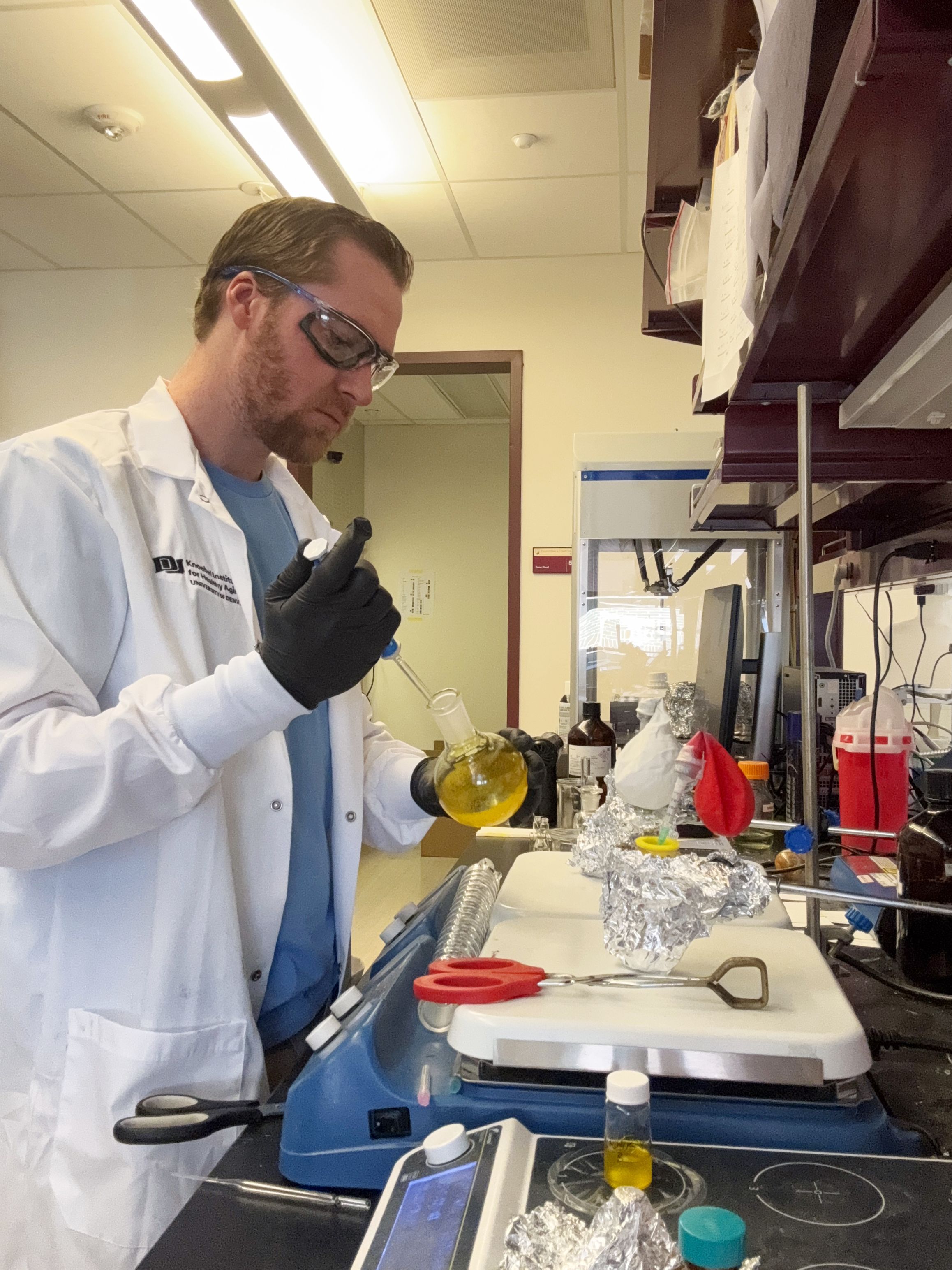
Dohoney knows that feeling all too well. He spent years watching his grandmother live with Alzheimer’s disease, so the longing for a treatment feels deeply familiar and drives him even further.
Even with one of the greatest breakthroughs in neurodegenerative diseases at their fingertips, the researchers still have a mountain to climb, and the Kumar Lab needs significant funding to continue its research. They will continue to test the drug in mouse models, with the goal of ultimately placing effective treatments into the hands of those who need them. For them, 2050 isn’t a deadline but a glimmer of hope.
The Kumar Lab includes a team of postdoctoral fellows and undergraduate and graduate researchers.
The Kumar Lab includes a team of postdoctoral fellows and undergraduate and graduate researchers.
 Built with Shorthand