
A late-season surge helped DU’s hockey team clinch its record-setting 11th national championship.
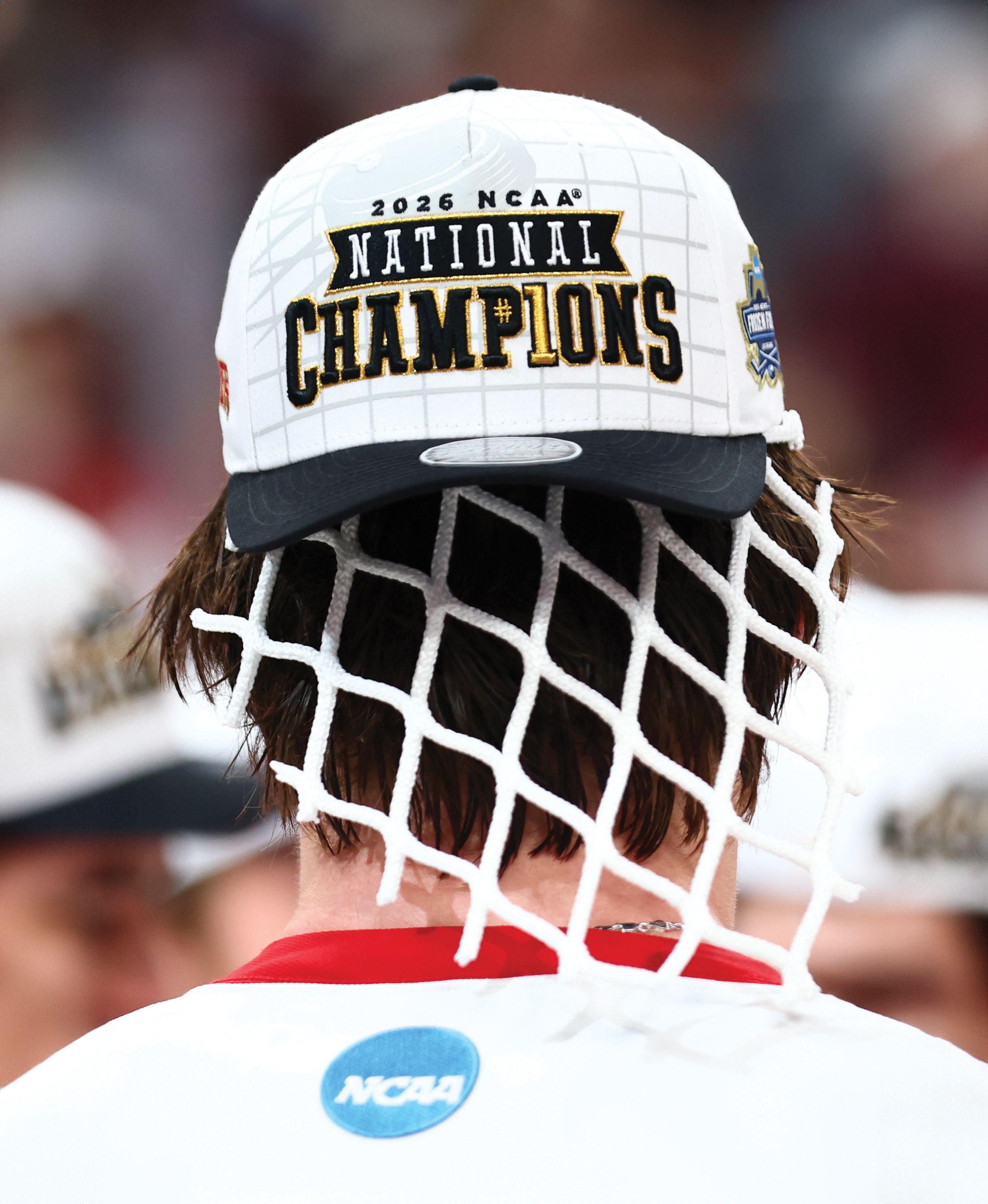
In the final seconds of the DU hockey team’s 6-2 win over Western Michigan to clinch a Frozen Four berth, ESPN’s John Buccigross summed it up best: “The standard is the standard, and the standard is Denver.”
The standards are indeed high for the Pioneers, who have repeatedly reached college hockey’s mountaintop with a record 11 national championships.
But the 2025-26 campaign didn’t always seem destined for the same greatness. Across December and January, Denver had a seven-game winless stretch that David Carle (BA ’12), the Richard and Kitzia Goodman Hockey Head Coach, called “a precarious situation.”
It was a tale of two seasons: Ten of the Pioneers’ first 14 games were on the road, including long trips to Boston and Kalamazoo, Michigan. But starting in January, DU made just three short road trips over the final 16 games of the regular season.
Consistent time on home ice, a healthy lineup, and NCAA regional matchups held close to home all helped the Pioneers prosper, and they rode a 14-game winning streak into the NCAA championships—the Frozen Four—in Las Vegas. There, they prevailed in a thrilling semifinal showdown with Michigan. They went on to defeat Wisconsin to claim the championship in a come-from-behind victory that showcased DU’s trademark patience and determination.
A goalie made for the moment
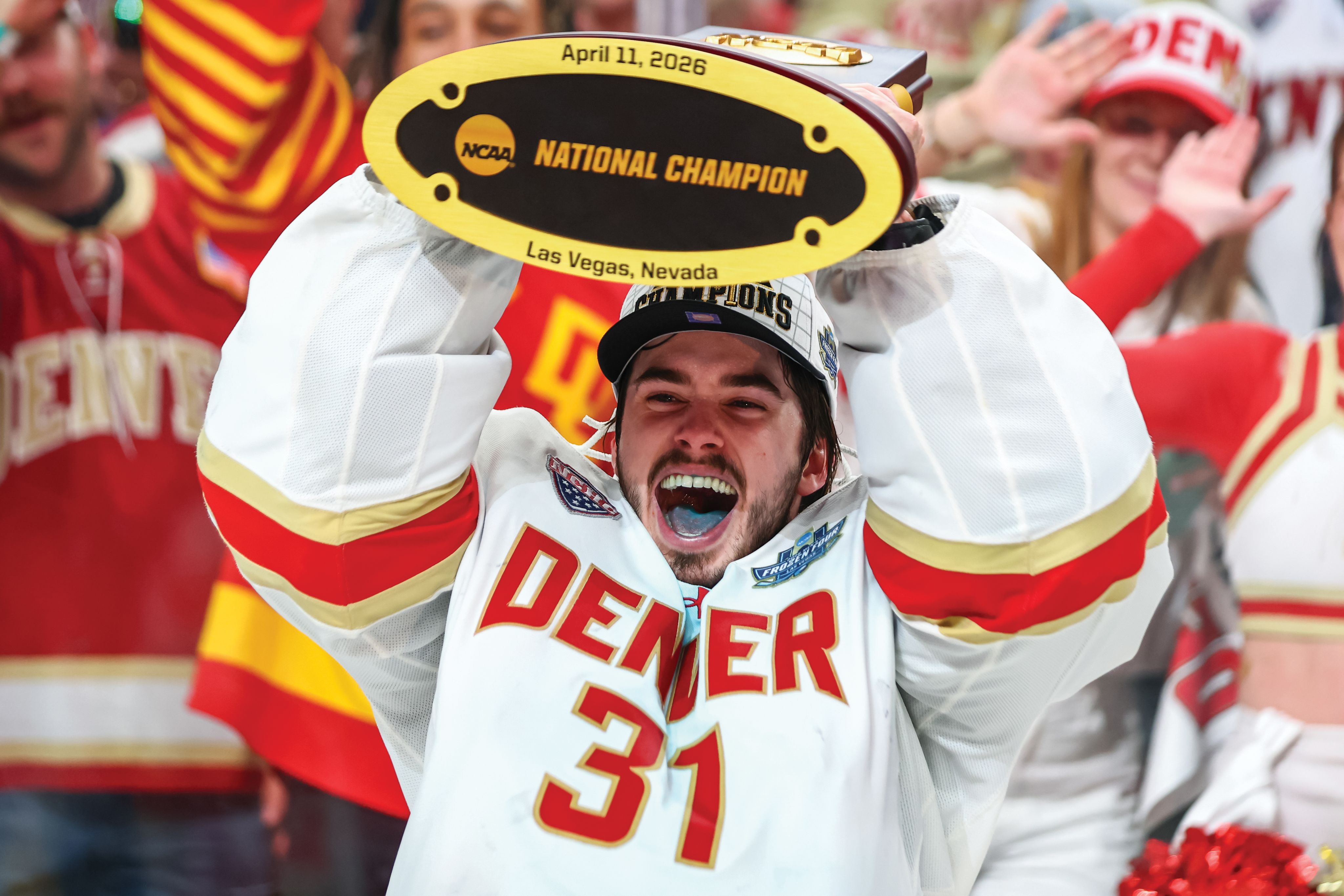
A big part of the Pioneers’ unbeaten streak was Johnny Hicks, the freshman goalie who was named the Most Outstanding Player in the National Collegiate Hockey Conference’s end-of-season tournament, the Frozen Faceoff. Hicks took the reins at a pivotal point for the team, when Quentin Miller had just snapped the seven-game losing streak in a win over North Dakota. The following weekend, though, Miller exited the game early with an injury, and Hicks came on to stop 22 shots in a victory over St. Cloud State on Jan. 24.
“To come in when he did, to be unfazed, to be the calmest person in the room—I think that speaks to his preparation, his focus, and his attention to detail,” Carle said. “Certainly, he’s been excellent for us on the stretch run.”
The Pioneers didn’t lose the rest of the way, and Hicks posted a .958 save percentage with 1.12 goals against average, both the best in the NCAA by large margins. He was one of four freshmen goalies between the pipes during the Frozen Four.
Rookies make their mark
Hicks wasn’t the only freshman making waves for the Pioneers. Miller was also a freshman, as were Clarke Caswell, Kristian Epperson, Brady Milburn, Eric Jamieson, Kyle Chyzowski, Payton Nelson, Brendan McMorrow, and Reid Varkonyi. Miller and Hicks were steady in net, while the other eight first-year players contributed 120 of the team’s 395 points going into the Frozen Four.
While some of those players come from traditional recruiting pipelines like the amateur United States Hockey League (USHL), others were recruited from the Canadian Hockey League (CHL)—whose players just became eligible to play in the NCAA.
The CHL is the umbrella organization that governs what are widely considered the three best junior hockey leagues in the world: the Western Hockey League, the Ontario Hockey League, and the Quebec Maritimes Junior Hockey League. Because players in those leagues receive stipends and can sign entry-level contracts with the NHL, the NCAA long considered them professionals and barred them from playing college hockey.
The emergence of name, image, and likeness (NIL) rules in college athletics changed the landscape, however, and gave NCAA eligibility to players in the CHL this past offseason. The result was an influx of freshmen from a new recruiting frontier.
Most of the CHL players who joined the Pioneers came from the Western Hockey League, which includes teams from western Canada and the Pacific Northwest. For Carle, this new pipeline is a throwback to the days of legendary coach Murray Armstrong, who led DU from 1956 to 1977 and won national championships in 1958, 1960, 1961, 1968, and 1969.
“[With] Murray Armstrong coming down from Regina [Saskatchewan] and bringing many great players and families … for us, it’s kind of a reversion back to how it was pre-1973,” Carle said.


The lead-up in Loveland
On the road to the Frozen Four, DU hosted an NCAA regional at Blue Arena in Loveland, Colorado, for the third time in program history. The Pioneers opened play with a 5-0 beatdown of Cornell behind goals from Jake Fisher, Kieran Cebrian, Sam Harris, Caswell, and Rieger Lorenz.
Two nights later, they followed that up with the 6-2 victory over Western Michigan. It was the sixth matchup of the season between the two squads and the fourth postseason meeting in the past two years. The win avenged a semifinal loss for the Pioneers in last year’s Frozen Four, when Western Michigan went on to win the national championship.
“I want to commend the fans who came out and made this the best regional we’ve been part of, from an atmosphere perspective,” Carle said after the win.
A blue-blood battle
In Las Vegas, DU faced perhaps its toughest test of the season during the semifinal battle against Michigan. The Pioneers and Wolverines are ranked first and second, respectively, for the most NCAA Division I college hockey national championships. DU broke the tie when they won the 2024 title—their 10th—and further cemented their status as a hockey powerhouse with this year’s win, while Michigan has been in a championship drought since 1998.
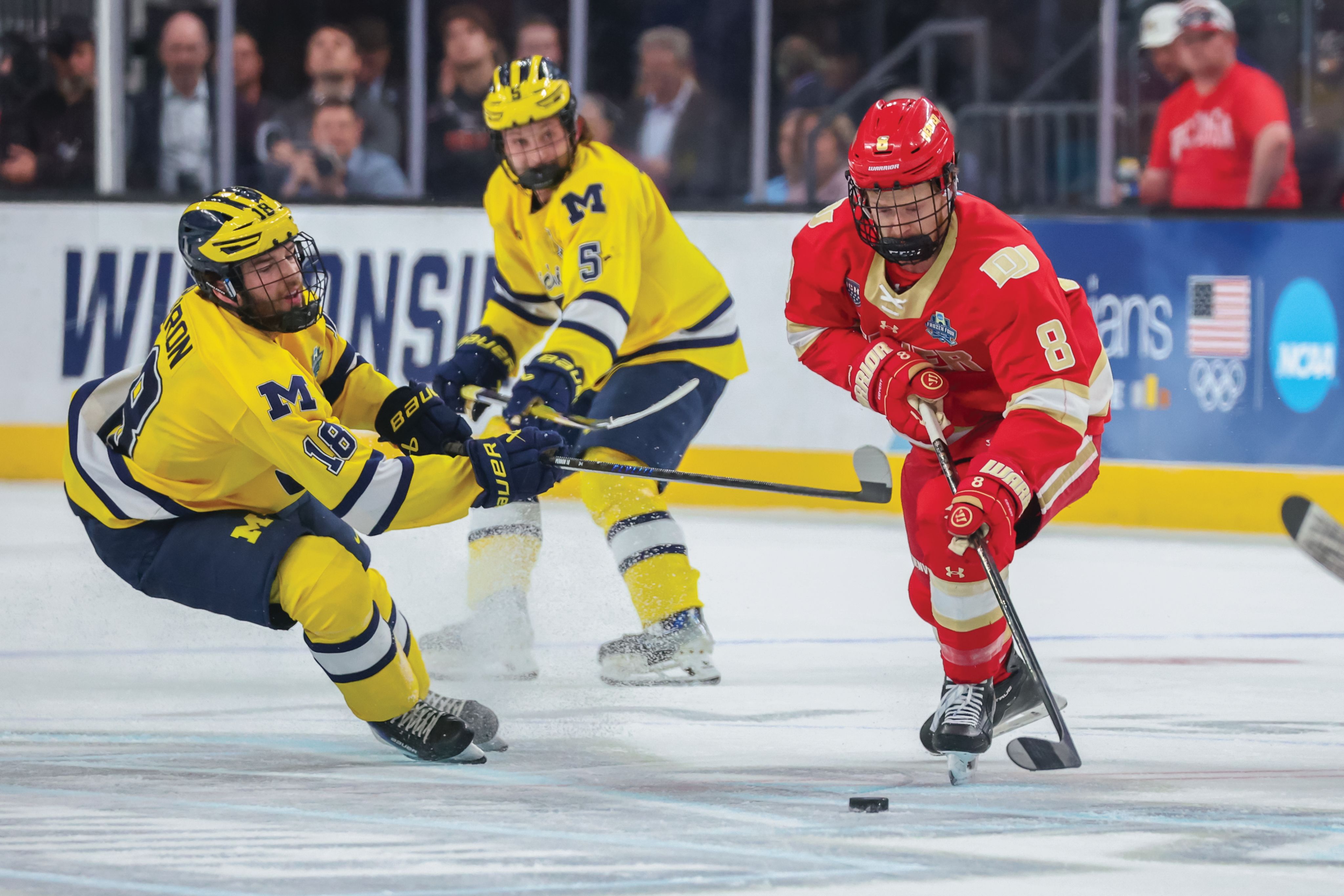
In addition to being the most storied programs in college hockey, the teams also included two of this year’s three Hobey Baker Hat Trick award finalists. DU junior Eric Pohlkamp led the Pioneers and all defensemen nationally in scoring with 39 points, while his 18 goals set an NCHC record for defensemen. Meanwhile, Michigan senior forward T.J. Hughes, who had 21 goals and 35 assists, led national scoring with 56 points. The award ultimately went to Max Plante from University of Minnesota Duluth, a forward with 25 goals and 52 points.
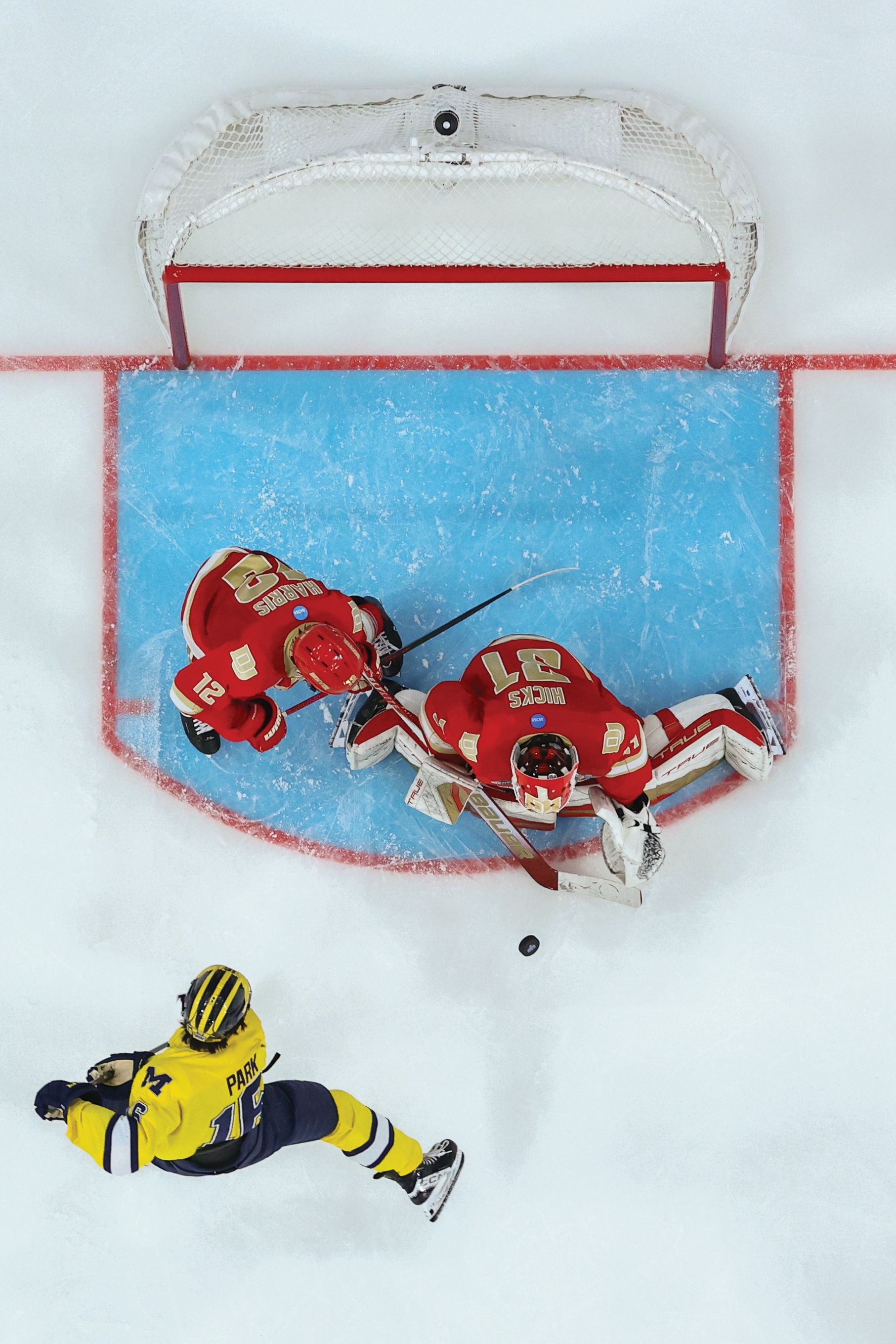
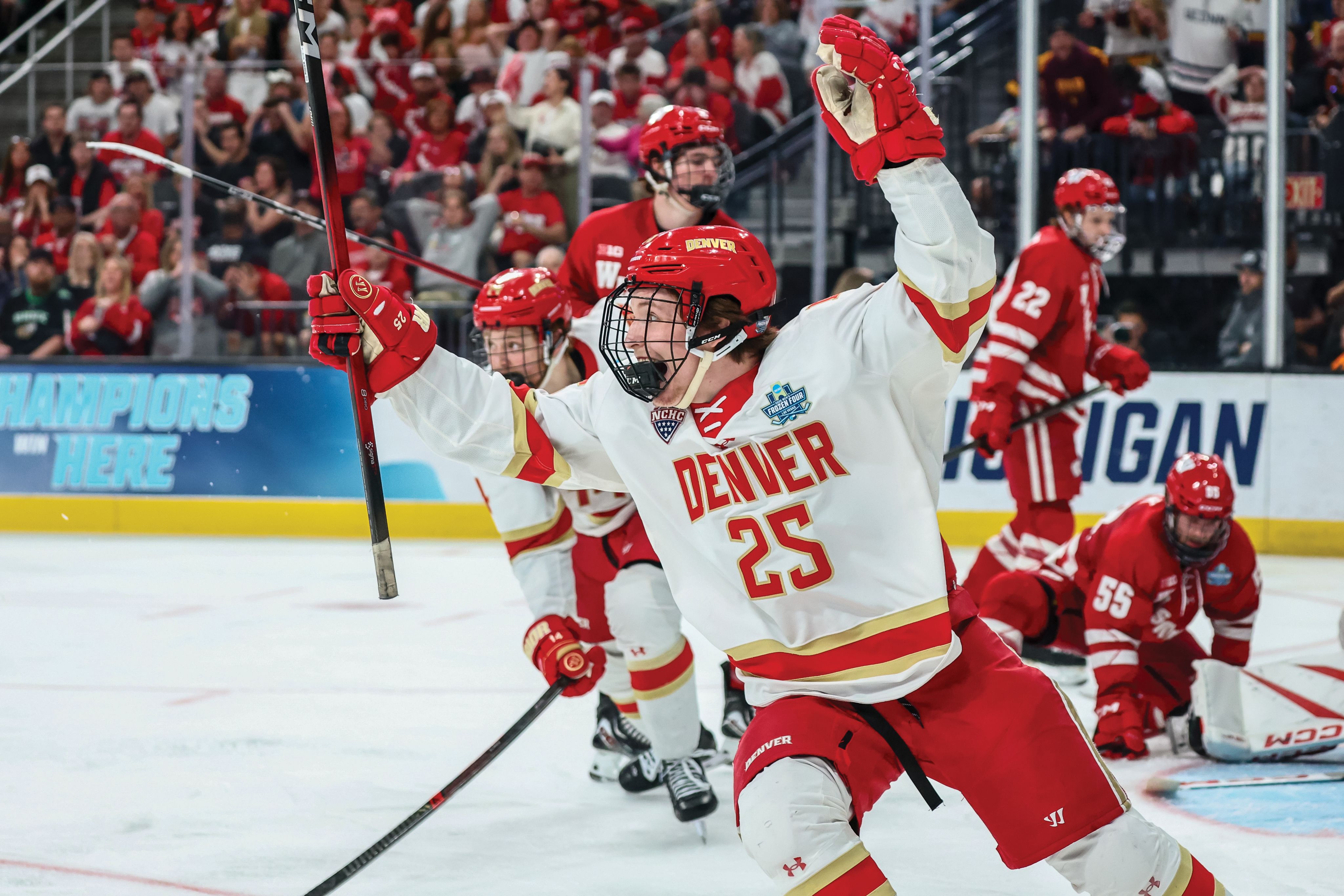
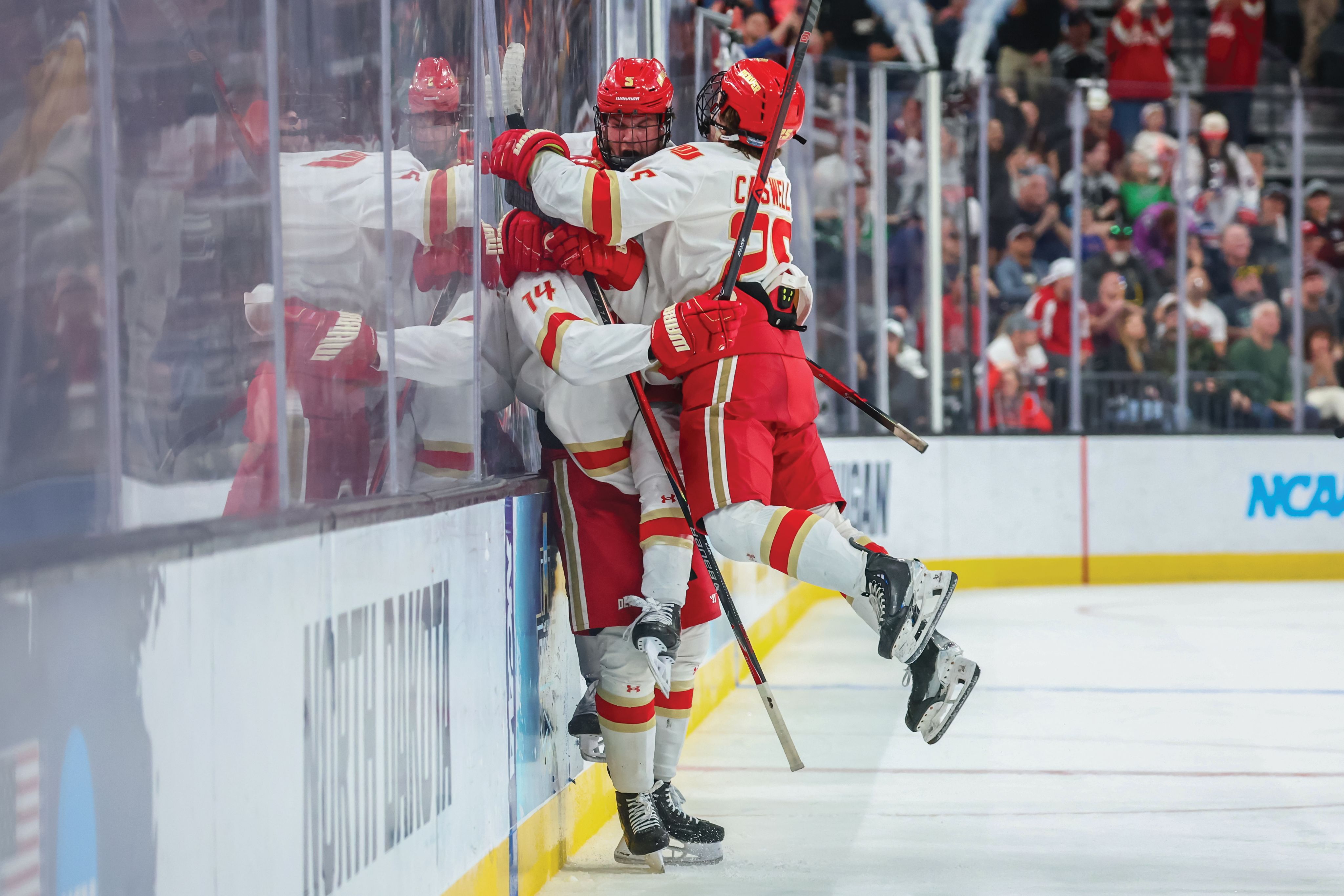
As it turned out, DU was more than up to the test. The Pioneers got goals from Chyzowski and Cale Ashcroft during the first and second periods, but they trailed 3-2 in the third until Caswell tied the game with less than three minutes remaining in regulation. Neither team scored in the first overtime, but DU senior captain Kent Anderson put the game winner in the net a little over halfway through the second overtime. At just over 92 minutes, it was the longest game in program history.
A comeback for the crown
When it came time for the championship game against Wisconsin, the ice was firmly tilted against the Pioneers for the first two periods and into the third. Denver entered the game bruised from the double-overtime win two days earlier, and with Wisconsin leading 1-0, the Pioneers trailed in shots—26-6 on goal and 58-22 overall. For the second straight game, Hicks had been peppered by a flurry of shots with little relief.
None of that mattered, though, when Lorenz got perhaps the grittiest—and certainly the most meaningful—goal of his career. The senior was in front of the net when Wisconsin goalie Daniel Hauser surrendered a rebound off a shot from Garrett Brown. The first attempt to jam it home was stopped, but the second slipped through to tie the game with 12:29 remaining.
“It’s a one-shot game after two [periods],” Carle said in an interview with ESPN after the game. “We finally got one to the net, and [Lorenz] was able to hang around that area. It certainly gave our guys a lot more belief.”
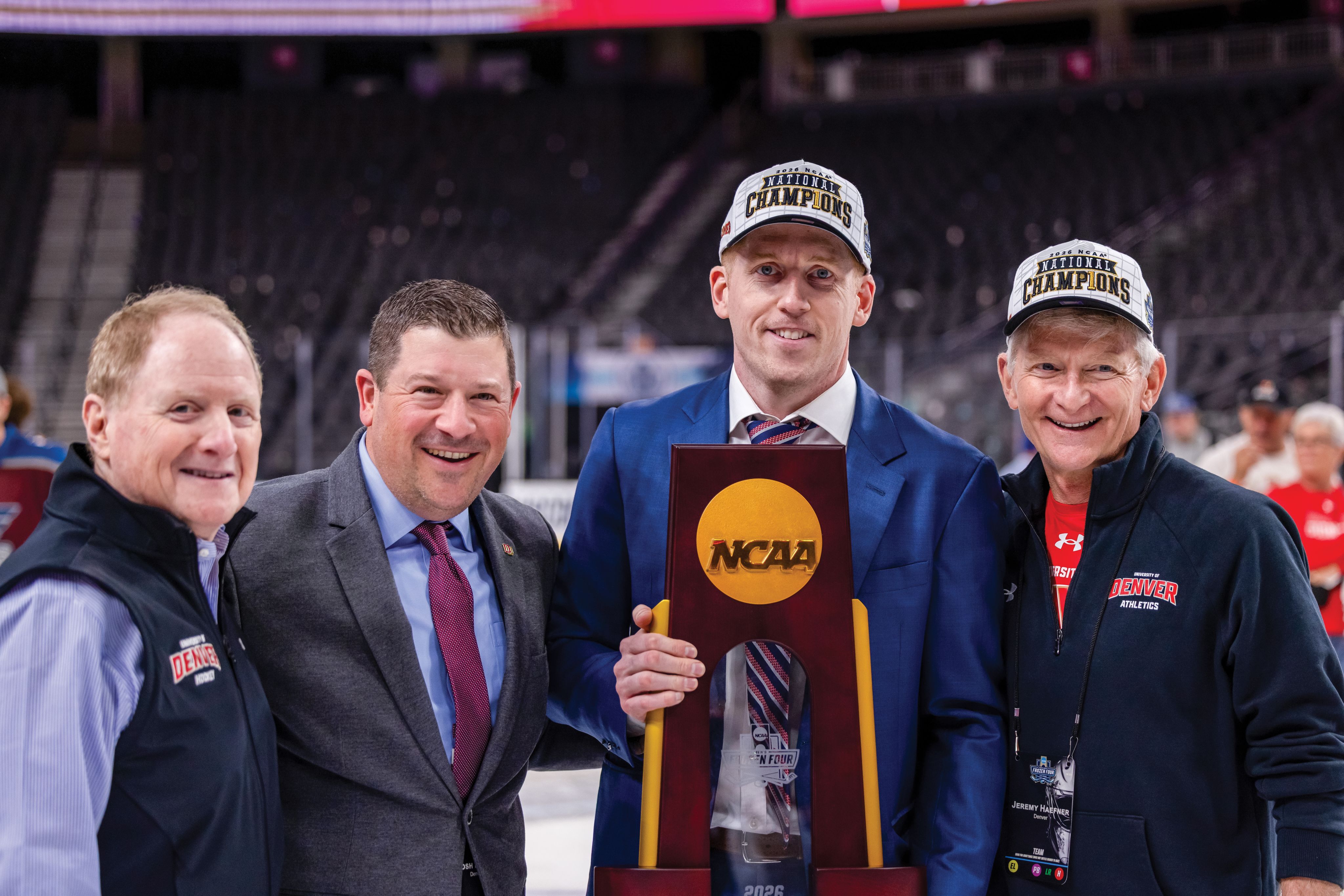
Indeed, the goal injected new life into the Pioneers, and Chyzowski tipped in Boston Buckberger’s slapshot with 5:52 remaining to lift the Pioneers to victory.
Driven by determination
After a second consecutive game spent enduring numerous shots and intensely physical play, Carle said he was proud of his team’s determination.
“We weathered it well,” he said. “[Wisconsin] threw a lot of stuff to the paint, a lot of stuff off the rush. We were finally able to crack them a little, obviously, and possess some pucks. We got a puck on the net ourselves and capitalized. We found a way to make two plays in the third.”
Hicks was selected as the Frozen Four’s Most Outstanding Player after a second consecutive game of highlight-reel stops. He finished with 29 saves, including nine in the third period, and finished his first-year campaign without losing a game since taking over the starting job in January.
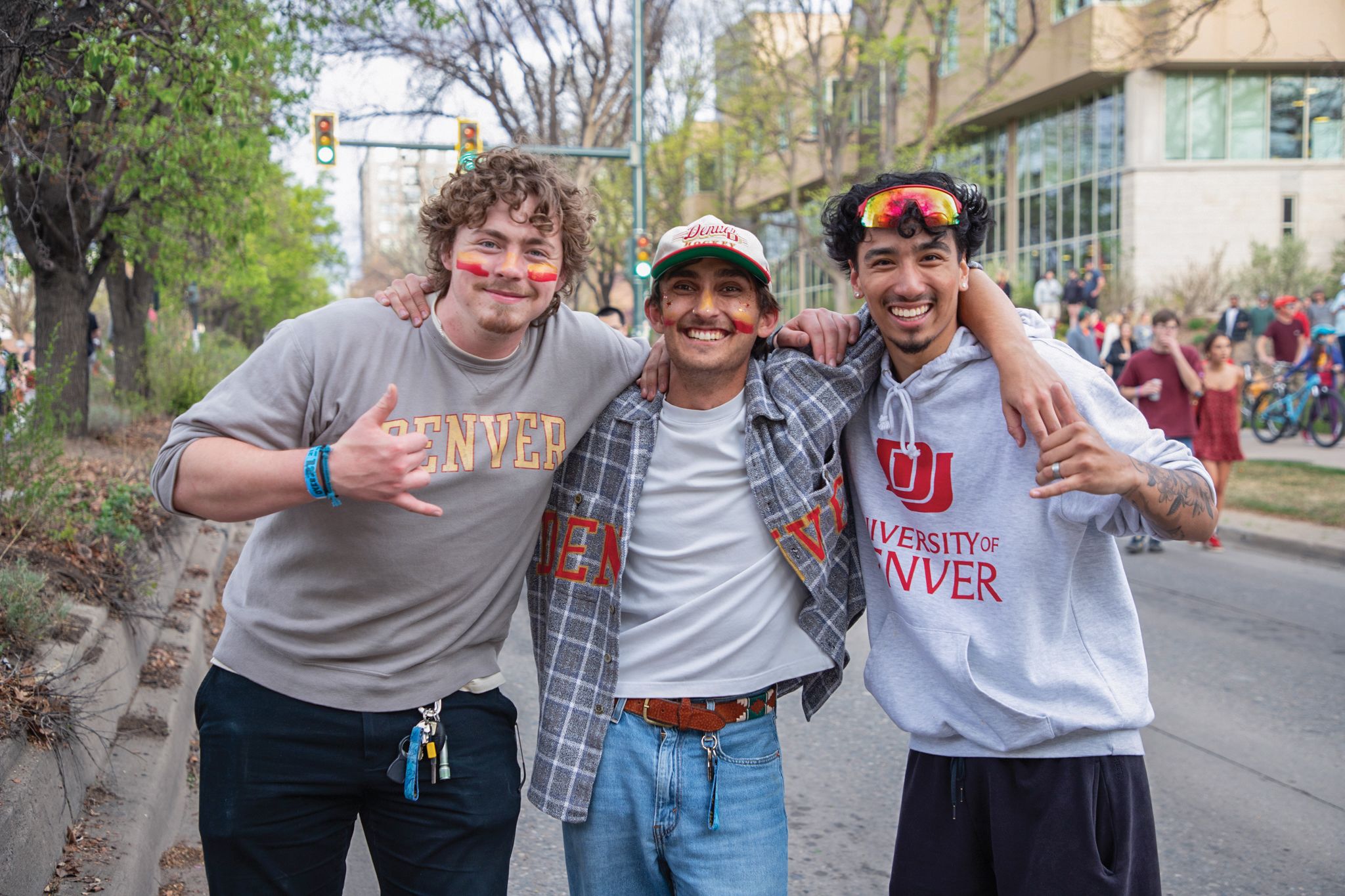
Back in Denver, the team celebrated the historic victory with the DU community at Magness Arena. Looking back at a roller coaster season with an outcome few thought possible, Carle summed it up perfectly.
“We were 13-11, our backs were against the wall. We could have packed it up then, but this group really dug in,” he told the crowd. “They committed to each other, to themselves, and to the program—and if we made it through that adversity, we all thought something special like this could happen.”


 Built with Shorthand