
Connecting the Dots
4D Faculty Teaching Fellows bring people and ideas together to advance DU’s 4D Experience.
When DU’s Four-Dimensional (4D) Experience launched in 2022, it was rooted in the belief that education should be more than the sum of its parts. The educational model, designed to develop the whole person, seeks to help students deepen intellect, develop well-being, discover character, and design careers and lives of purpose. Three “drivers”—experiential learning, mentorship, and reflection—bring the four dimensions to life.
For Kate Rice, teaching assistant professor of French, this holistic approach to learning provided an opportunity to develop fluency in ideas that were already integral to her teaching. “I wanted a richer understanding of the four dimensions and how they were alive in my classroom, my own professional work, and my work with colleagues,” says Rice. That desire led Rice to join the inaugural cohort of 4D Faculty Teaching Fellows.
Members of the inaugural cohort of 4D Faculty Teaching Fellows, including Kate Rice (third from left) and Erika Trigoso Rubio (second from right).
Members of the inaugural cohort of 4D Faculty Teaching Fellows, including Kate Rice (third from left) and Erika Trigoso Rubio (second from right).
Launched in 2025 with the support of a grant from the national LearningWell Coalition, the program equips fellows to advance transformative, inclusive teaching within their colleges and schools. One of its goals is to help faculty translate 4D’s broader principles into concrete approaches that are authentic to their disciplines, rather than prescribing a single model.
“[The fellows] bring incredible perspectives about how we can infuse 4D across students’ learning by working together and breaking down silos,” says Laura Perille, PhD, executive director of the 4D Experience. Because what works in chemistry or geography courses differs from what works in language courses, she sees the fellows as helping translate 4D’s strategic priorities into approaches that work in their individual fields.
Erin Anderson-Camenzind, 4D director of faculty innovation, envisions the fellows as “weavers” of the 4D Experience. By creating space for interdisciplinary dialogue, the program allows faculty to learn from one another.
“Our 4D fellows are extending the network and connecting the dots, not only for their students but also for the faculty with whom they work,” says Anderson-Camenzind. The result is a more cohesive approach to teaching and learning across campus.
Learning in action
Perille notes that the 4D Experience needs to be woven throughout students’ time at DU to become a sustained, cohesive learning journey. The fellows help advance that effort in myriad ways.
Last fall, for example, Rice and five fellow faculty members formed a teaching circle to explore how First-Year Language Program courses—required for most first-year students—foster the 4D Experience. After conducting peer evaluations and assessing the results, they then surveyed 200 students to assess outcomes and invite students to reflect on their learning.
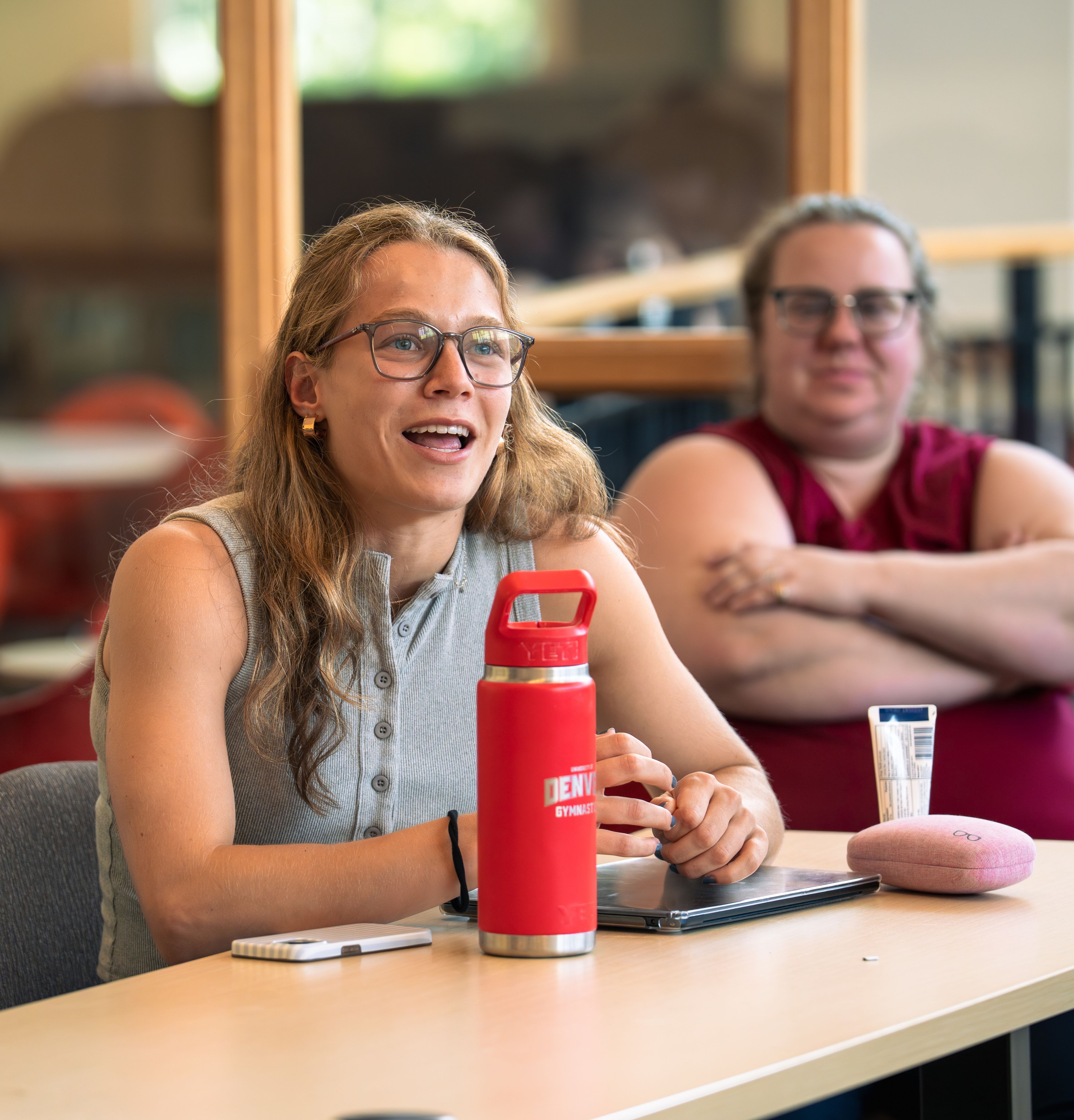
“Student responses reflected that all four dimensions are actively engaged during a 50-minute language class,” says Rice. For example, students could discuss their learning experience as an opportunity to build collaborative skills (while working with a partner or in a small group) and as a chance to listen with empathy and be curious rather than judgmental (through explorations of other cultures). Both are examples of skills that map directly to the four dimensions.

Real-world impact
A passion for field education has led Erika Trigoso Rubio, teaching professor of geography, to design several interterm travel classes. Whether exploring the Serengeti or traversing Antarctica, she has seen the same lesson emerge.
4D Teaching Fellow Erika Trigoso Rubio taught an interterm class in Antarctica, a prime opportunity for experiential learning. Photo courtesy of Tammy MacKenzie/Albatross Expeditions.
4D Teaching Fellow Erika Trigoso Rubio taught an interterm class in Antarctica, a prime opportunity for experiential learning. Photo courtesy of Tammy MacKenzie/Albatross Expeditions.
“When we trigger curiosity in our students, learning experiences stay with them in a more meaningful way,” says Trigoso Rubio, who has used her time as a fellow to explicitly approach the 4D framework as a driver for experiential learning. Working with like-minded faculty, she was able to share strategies from the field that can be applied in classroom settings.
“Taking an interdisciplinary approach allows us to reach more students,” Trigoso Rubio adds. With this in mind, she and a colleague from the biology department are leading a nine-day course on conservation in Tanzania in December. Also listed in the anthropology department, the course invites all DU students to develop “a more profound connection with the world,” she says.
That emphasis on curiosity, connection, and growth echoes Rice’s experience. For her, the fellowship has reinforced the importance of lifelong learning for educators, too. Rice says that recognizing her own 4D moments—embracing a growth mindset, for example, or trying a new approach—keeps her connected to students’ experiences.
The fellowship has also sharpened the sense of purpose she hopes to pass along. As she puts it, “Approaching the world with an open mind and a willingness to take risks in our learning helps us become resilient global citizens with the power to change our society for the better.”
 Built with Shorthand