
A Quantum Leap Forward
A $1 million federal grant is expanding quantum computing research and education at DU, including hands-on opportunities for undergraduate students entering a rapidly growing industry.
By Jesse King
Sam Smiley, a third-year physics PhD student at the University of Denver, sees a world of opportunity in quantum computing. The emerging field, which involves manipulating atoms to process information, is still in its infancy, but researchers hope powerful quantum computers will one day tackle tasks that today’s computers can’t. Smiley says the room for discovery is what makes it so exciting.
“As much as I love studying fundamental physics, quantum [computing] has so many applications,” says Smiley. “There’s so much potential impact.”
Now, more students at DU will be able to explore quantum computing, even at the undergraduate level, thanks to $1.03 million in direct spending from Congress. The earmark, meant to support quantum research and workforce development, is the first such grant DU has received in more than 20 years.
“Doing quantum computing—or even learning how to do it or ask research questions about it—takes high-level experimental equipment,” says Barry Zink, a physics professor who contributed to the grant application. “This funding will give us the tools we need to educate the next generation of people who will push this field forward.”
The College of Natural Sciences and Mathematics is launching a new quantum computing minor this fall, building on its existing Introduction to Quantum Computing course and a variety of courses in quantum materials. Zink says the new equipment will allow the school to create more courses that will provide hands-on opportunities for students.
Students who pursue quantum computing are getting in early to a growing industry. The federal government designated Colorado a “quantum technology hub” in 2023, and several companies and startups, including Quantinuum and Atom Computing, have established research centers here. DU is a member of Elevate Quantum, a consortium of more than 120 companies and universities working to support Colorado’s quantum industry.
“The goal is to make the Denver area the Silicon Valley of quantum computing,” says Mark Siemens, chair of NSM’s Department of Physics and Astronomy. “And we see DU helping to train workers for the quantum industry.”

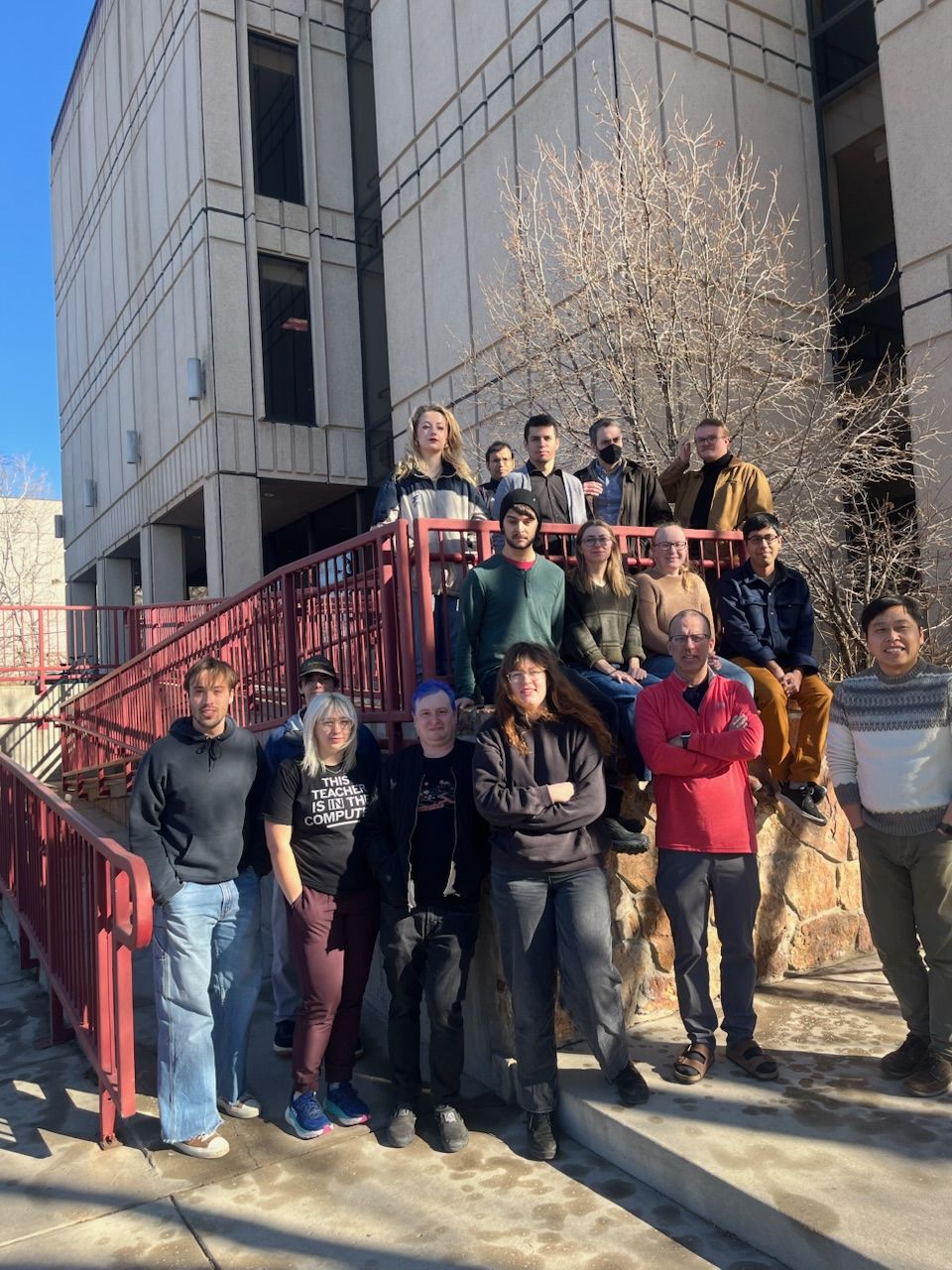
Some of the students and faculty working on quantum computing at DU, including Sam Smiley (in front, second from the left).
Some of the students and faculty working on quantum computing at DU, including Sam Smiley (in front, second from the left).
Quantum computers require cooling devices that look a little like giant chandeliers. While the processing chip of a quantum computer is tiny, the system's remaining parts can fill a whole room.
Quantum computers require cooling devices that look a little like giant chandeliers. While the processing chip of a quantum computer is tiny, the system's remaining parts can fill a whole room.
What is quantum computing?
Quantum computers are frequently described as better, more powerful versions of the computers we use today, but the two are completely different in how they work and what they are used for.
Classical computers work with “bits” of data representing binary values like “true/false” or “yes/no.” If you give a classical computer an equation, it will test solutions one at a time. Quantum computers, meanwhile, run on “qubits” that can represent combinations of all values at once. You can think of a qubit like a coin tossed into the air: Before it lands, it is neither heads nor tails but, technically, both. This quality, coupled with the fact that qubits can also exponentially increase their data capacity by “entangling” with one another, makes quantum computers especially powerful.
Despite this, Siemens says it’s unlikely quantum computers will ever be used in the home. Quantum computing is so complex and delicate that it’s not effective for the everyday problems our phones and laptops solve quickly. Rather, quantum computing excels at what Siemens calls “quantum problems,” simulating interactions at a molecular level.
“It could be helpful for things like pharmaceuticals and designing drugs,” he explains. “In a lot of these areas, scientists use approximations to guess what to expect when they combine molecules in different ways, but with quantum computing, they could run the calculation without needing to actually make the molecules and test them.”
Siemens says quantum computing could also help develop new materials. Smiley sees other potential applications in financial modeling and GPS navigation. And already, quantum computers have proven capable of cracking some of the math problems used to encrypt data, pushing companies to develop more robust encryption methods.
A field ripe for research
In addition to figuring out what quantum computers can do, much of today’s research is focused on improving systems and measuring results. Siemens says quantum computing is a delicate process: You can give a quantum computer an equation, and it may quickly test solutions, but trying to pull the correct answer will cause the entire dataset to collapse.
“You need to be measuring just right to get meaningful information,” he explains. “A lot of research is working on the technology: making quantum systems you can control more precisely, that interact less with the environment.”
Quantum computing research requires the efforts of physicists, mathematicians, and engineers alike. Siemens says companies need mathematicians to work on algorithms, electrical engineers to analyze circuits, and physicists to understand overall systems. He and Smiley both note the new federal funding will help DU students get ahead of the game.
“My experience in the lab has helped me understand quantum computing not just in a theoretical way, but a practical one. I think this funding will enable NSM to enhance its courses and potentially focus more on fabrication and the lab work itself,” says Smiley. “There aren’t a lot of institutions that have the funding to prepare students to enter this industry at a bachelor’s level—that’s why I’m so excited about this.”
 Built with Shorthand