
Shaping American Art and Denver’s Creative Landscape


The University of Denver has long been a cornerstone of artistic innovation, making a lasting impact on American art and Denver’s vibrant art scene. From sculptures that have helped define Denver’s identity to influential contributions in photography, illustrations, painting, and more, DU’s students, alumni, and faculty have left an undeniable mark on the arts in Colorado and across America. And you don’t have to look far to see them.
Lawrence Argent: The Vision Behind Denver’s “Big Blue Bear”
If you’ve visited downtown Denver, chances are you’ve passed the iconic “Big Blue Bear” peering into the Colorado Convention Center. Officially titled “I See What You Mean,” the 40-foot sculpture was created in 2005 by visual artist Lawrence Argent, a longtime professor at DU’s School of Art and Art History. Argent, who taught at DU from 1993 and was named Professor Emeritus in 2017, was on the forefront of an art movement known as “digital sculpting,” combining computer software with his artistic vision to plan and design his artworks with mind-bending angles and whirls.
The “Big Blue Bear,” as it’s affectionately known, depicts a towering American black bear in a striking, deep azure blue. Argent had originally envisioned the bear in Colorado-inspired natural hues, such as sandstone reds, but ultimately opted for the iconic blue after creating a printed mockup of the sculpture. The result is a playful yet imposing figure that has become a symbol of Denver’s creative spirit.
Argent’s influence extends far beyond Denver. His works are showcased globally, from California to China. Closer to home, you can find “Whispers,” a limestone and bronze sculpture outside of DU’s Ritchie Center. Modeled after 3D scans of DU students, the work is an ode to dialogue, civil discourse, and the exchange of knowledge — values central to the university’s mission.

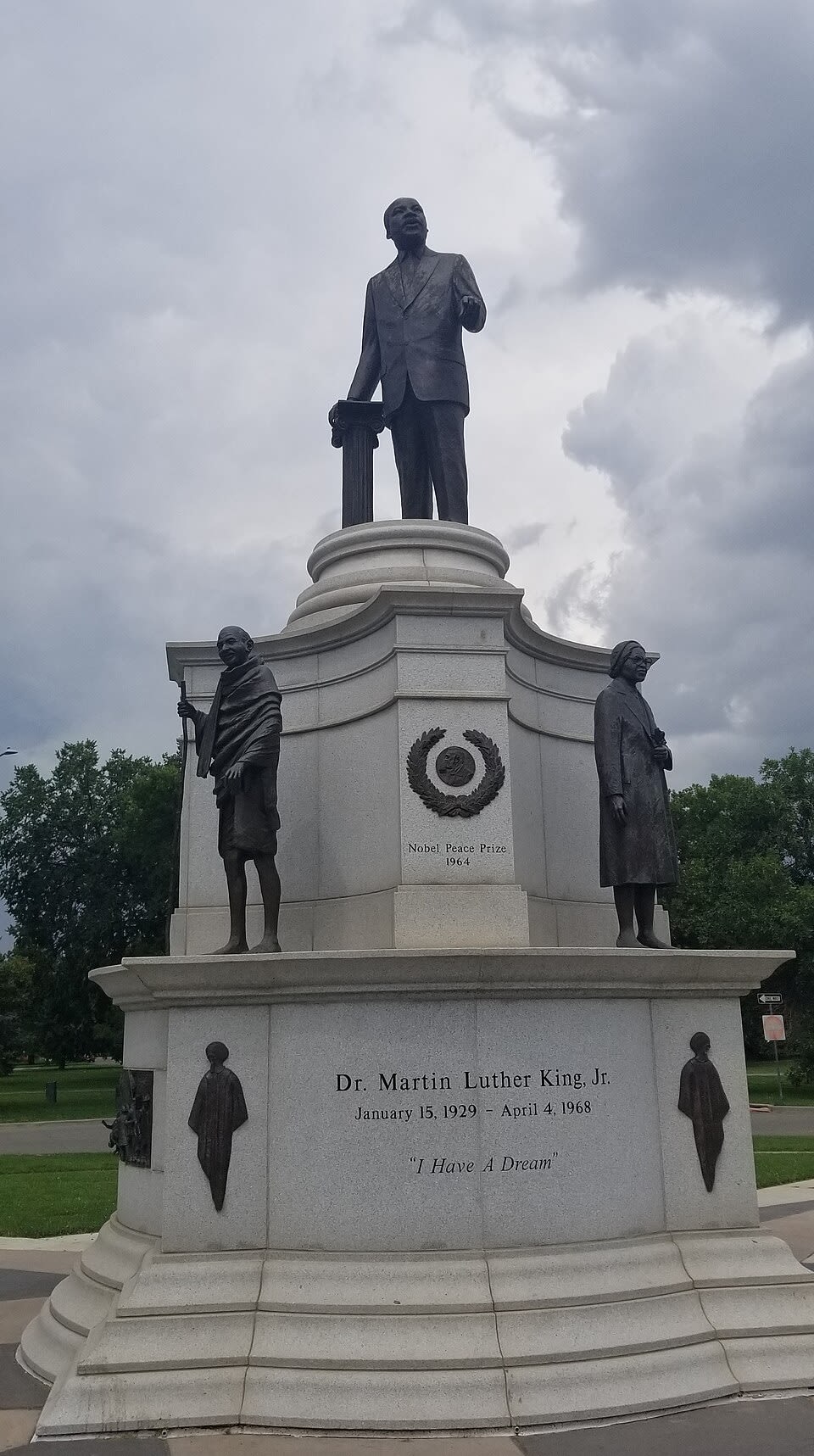
Statue of Martin Luther King Jr. by Ed Dwight
Statue of Martin Luther King Jr. by Ed Dwight

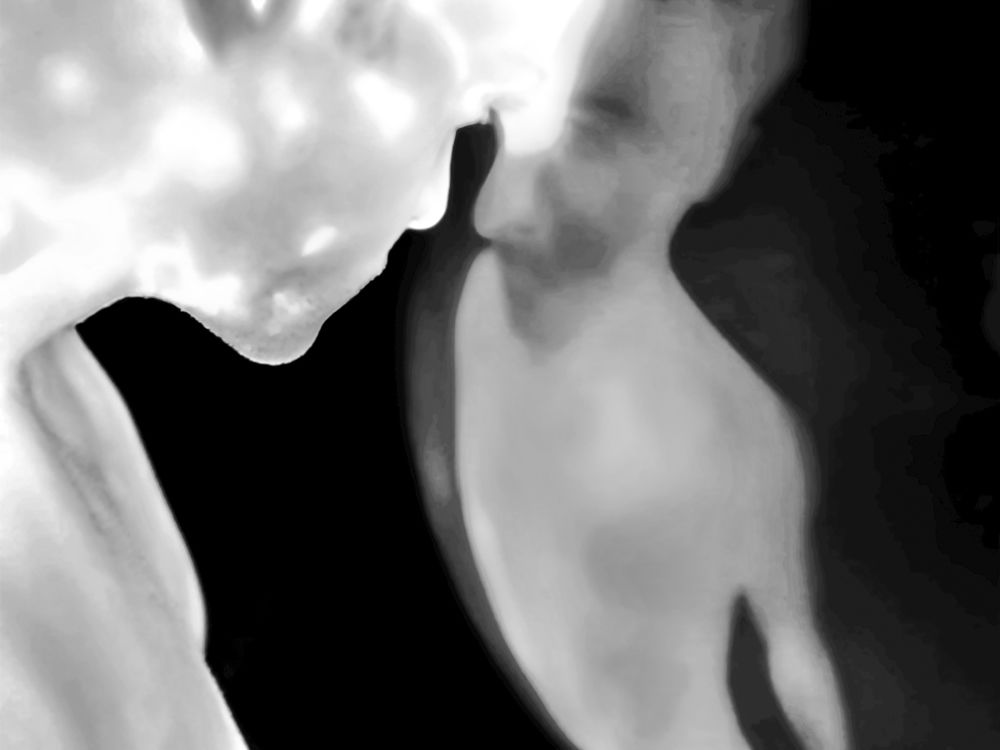
©Linda Alterwitz, “Untitled Number 3” from the series Signatures of Heat
©Linda Alterwitz, “Untitled Number 3” from the series Signatures of Heat

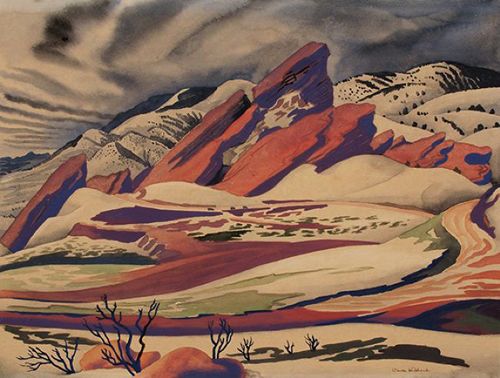
Red Rocks in April, c.1935, watercolor on paper, by Vance Kirkland.
Red Rocks in April, c.1935, watercolor on paper, by Vance Kirkland.

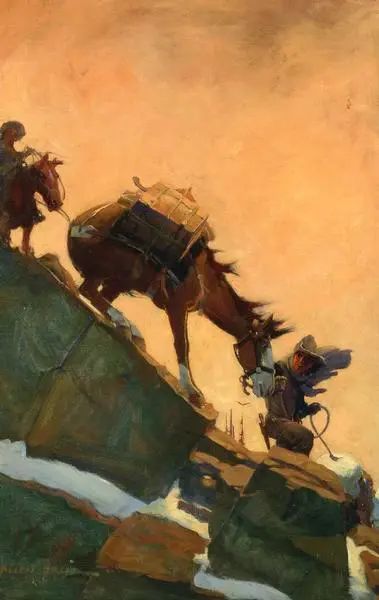
Painting by Allen Tupper True
Painting by Allen Tupper True
Ed Dwight (MFA ‘77): From Aerospace Trailblazer to Sculptural Storyteller
DU alum Ed Dwight (MFA ‘77) has led a truly extraordinary life journey. Born in 1933 in Kansas City during the era of segregation, Dwight joined the U.S. Air Force in the 1950s and broke barriers as the first Black American selected for NASA’s training program at the behest of President John F. Kennedy. While he was ultimately not selected for the astronaut corps — the cause of much controversy — Dwight completed his training at the Aerospace Research Pilot School and later moved to Denver to work for IBM.
Dwight made a career pivot in the 70s and earned his MFA in sculpture from DU in 1977, channeling his experiences into art that memorializes the civil rights movement and the Black experience in the American West.
His “Statue of Martin Luther King Jr.” in City Park, installed in 2002, commemorates civil rights leaders like Frederick Douglass and Sojourner Truth, who surround King in the composition. Dwight’s innovative use of negative space and his ability to capture emotion have earned him widespread acclaim..
Dwight’s work is featured in state capitols and National Park Service sites across the U.S., often celebrating themes like jazz and blues performers, as well as Black American trailblazers in athletics.
In 2024, at the age of 90, Dwight made history again as the oldest person to participate in suborbital spaceflight, a mission sponsored by Denver-based nonprofit Space for Humanity. From the skies to the art world, Dwight’s legacy is one of resilience and creativity.
Linda Alterwitz: Exploring the Unseen Rhythms of Life
Beyond sculpture, artists from DU have experimented with different mediums to explore abstract concepts like the cosmos and the natural world. DU alum Linda Alterwitz (MFA ‘84) redefined her artistic identity through expressionist photography. Initially a painter, Alterwitz shifted to photography in the 2000s after a life-alerting brain tumor diagnosis. She had always leaned into abstract impressionism, and her health situation inspired her to incorporate medical imagery, such as MRI scans and anatomical visuals, into her work, blending them with natural landscapes and portraits to explore “the unseen rhythms” of the world.
Currently based in Nevada, Alterwitz’s work has been exhibited nationwide, including at the New Mexico Museum of Art, the Lancaster Museum of Art and History, Aberystwyth Arts Centre, the Los Angeles Center for Digital Arts, and more. Her artwork, “While I Am Still Here,” completed in 2024, overlays PET scans with low-tech landscape photography, creating ghostly allusions to her medical and mental journey. In weaving clinical imagery with the natural environment, Alterwitz invites viewers to confront the fragility of life with both hope and introspection.
Vance Kirkland: Shaping Colorado’s Artistic Legacy
Kirkland is an enduring figure in the Colorado art scene. As a professor and the founding director of DU’s School of Art and Art History, Kirkland’s career spanned realism, impressionism, surrealism, and abstract expressionism, resulting in a vast catalog of over 1,200 paintings. His work often drew inspiration from Colorado’s landscapes, from Red Rocks to mountain ghost towns, and evolved into increasingly abstract forms with bright colors and an array of techniques that were inspired by his experience with synesthesia — a condition that allowed him to experience colors as sounds.
Kirkland’s teaching career at DU spanned from 1929 to 1932 and again from 1946 to 1969. In addition to his work for DU, he founded the Kirkland School of Art in the 1930s and collaborated with the University of Colorado Denver. His legacy lives on through the Vance Kirkland Foundation, established in 1996, and the Kirkland Museum of Fine & Decorative Art, which opened in 2003 to celebrate Colorado and the surrounding region’s rich artistic heritage.
Allen Tupper True: Illustrating the American West
A contemporary of John Singer Sargent, Allen Tupper True was a prominent illustrator and muralist whose work shaped the perception of the American West. Born in Colorado Springs in 1881, True spent his childhood in Texas and Mexico before his family settled in Denver when his mother became President of the Denver School Board. After high school, True studied at the University of Denver for two years and then enrolled at the Corcoran School of Art and Design at George Washington University in Washington, D.C.
True’s early career included illustrations for magazines like the Saturday Evening Post, Collier’s Weekly, and Scribner’s Magazine. From there, he began to illustrate books and their covers. His transition to muralism began in 1912 when he sold an easel painting to Anne Evans, daughter of Colorado Governor John Evans, who installed it as a mural in her mountain home. By 1918, he was commissioned to paint eight panels for the Wyoming State Capital. His murals, which depict Native American and Indigenous communities, railways, cowboys, and stage coaches, can also be found in the Missouri and Colorado State Capitols, as well as Denver landmarks like the historic Brown Palace Hotel and the Denver Public Library. True’s work captures the spirit of the American West, preserving its stories for future generations.





The Denver Difference campaign is empowering DU to lead with a bold, innovative approach and redefine higher education—driving a lasting impact on the public good through its visionary people, programs, and places.
Be the first to hear about upcoming stories like this by signing up below!
University of Denver | Advancement | 2199 S. University Blvd | Denver, CO 80208 | advancement@du.edu
 Built with Shorthand